Introduction
Software development is a complex process that
involves multiple stages, teams, and technologies. Without a structured
approach, projects can quickly become disorganized, leading to delays,
increased costs, and poor-quality products. To avoid these issues, development
teams follow a systematic process known as the Software Development
Lifecycle (SDLC).
The
Software Development Lifecycle provides a clear framework for planning,
creating, testing, and deploying software applications. It ensures that every
stage of development is carefully managed, documented, and optimized for
efficiency.
Businesses
and development teams rely on SDLC because it improves product quality, reduces
risks, and ensures that projects are completed within the defined timeline and
budget. In this article, we will explore the key phases of the SDLC, popular
development models, best practices, challenges, and tools used throughout the
software development process.
What is Software Development Lifecycle (SDLC)?
The Software Development Lifecycle (SDLC) is a
structured process used by software development teams to design, develop, test,
and deploy software systems efficiently. The main purpose of SDLC is to create
high-quality software that meets user requirements while staying within project
timelines and budget constraints.
Key
objectives of SDLC include:
1.Improving product quality by following standardized processes
2.Reducing development risks through careful planning and analysis
3.Controlling
project timelines and costs with proper project management
4.Enhancing
collaboration between developers, designers, testers, and stakeholders
By following SDLC, organizations can ensure
that software projects are well-organized and successfully delivered.
Why SDLC is Important
for Software Projects
The Software Development Lifecycle plays a
critical role in successful software development. It provides a structured
roadmap that guides teams through each stage of the project. One of the main
benefits of SDLC is clear project planning and documentation. Teams
understand project goals, requirements, and timelines from the beginning, which
reduces confusion during development. SDLC also improves software quality
and reliability because testing and validation are integrated throughout
the development process. Another major advantage is effective risk
management. By identifying potential issues early in the development cycle,
teams can resolve problems before they become costly. Additionally, SDLC
enhances team coordination and workflow. Developers, designers, testers,
and project managers can collaborate efficiently because each phase has clearly
defined responsibilities. Finally, SDLC supports long-term maintenance and
scalability, making it easier to update software as business needs evolve.
Key
Phases of the Software Development Lifecycle
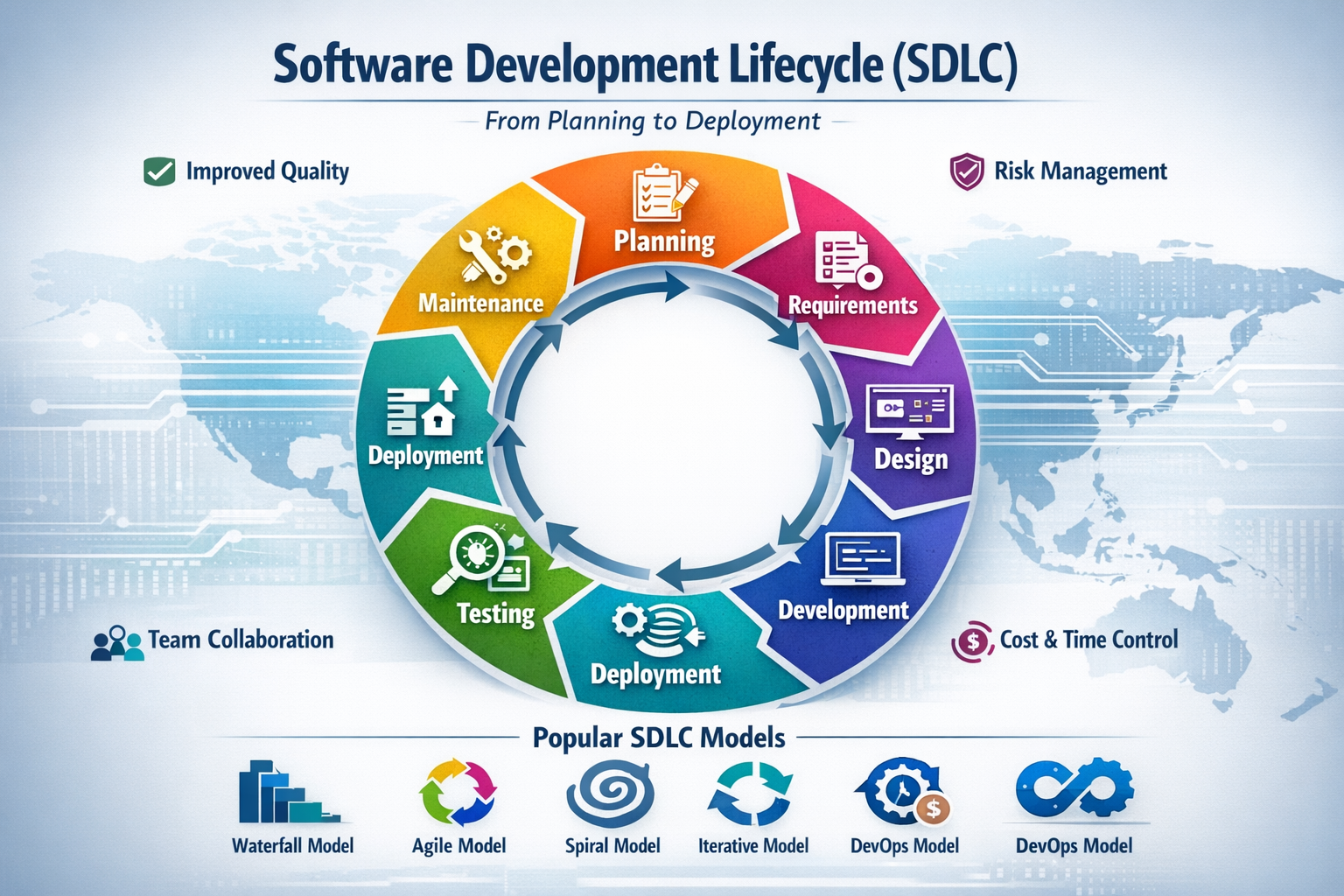
1 Planning Phase
The planning phase is the starting point of
the SDLC. During this stage, organizations identify business needs and
determine the purpose of the software project. Key activities include defining
project objectives, determining the scope of the project, and allocating
resources such as budget, tools, and team members. Teams also conduct risk
analysis and feasibility studies to evaluate whether the project is technically
and financially viable.
2 Requirement Analysis
In this phase, developers and analysts gather
detailed requirements for the software system. Both functional requirements
(what the system should do) and non-functional requirements (performance,
security, usability) are identified. Communication with stakeholders is
essential to ensure that all expectations are clearly defined. The collected
requirements are documented in a Software Requirement Specification (SRS),
which acts as a blueprint for the development team.
3 Design Phase
Once requirements are finalized, the design
phase begins. This stage focuses on defining the system architecture and
technical structure of the software. Developers plan the system architecture,
design the database structure, and outline the user interface (UI) and user
experience (UX). Teams also decide which programming languages, frameworks, and
technologies will be used to build the application.
4 Development Phase
The development phase is where the actual
coding takes place. Developers write the software according to the design
specifications defined in the previous phase. Teams follow coding standards and
best practices to ensure the code is clean, maintainable, and efficient.
Collaboration among developers is essential, and version control systems are
often used to manage code changes and track progress.
5 Testing Phase
Testing is a critical phase in the SDLC
because it ensures the software functions correctly and meets quality
standards. During this stage, testers identify bugs, defects, and performance
issues. Several types of testing are conducted, including: Unit Testing –
testing individual components Integration Testing – verifying that modules work
together System Testing – evaluating the complete system User Acceptance
Testing (UAT) – ensuring the software meets user requirements Thorough testing
ensures that the final product is reliable and ready for deployment.
6 Deployment Phase
In the
deployment phase, the completed software is released into the production
environment. This stage involves installing the system, configuring servers,
and ensuring that the application runs smoothly. Teams also monitor the system
closely during the initial rollout to detect any unexpected issues. Successful
deployment ensures users can access and use the software effectively.
7 Maintenance Phase
After deployment, the software enters the
maintenance phase. This stage focuses on fixing bugs, updating features, and
improving system performance. Maintenance also includes applying security
patches and optimizing the system to ensure it continues to meet user needs
over time. Continuous monitoring helps identify areas for improvement and
ensures long-term reliability.
Popular SDLC Models
Different software projects may require
different SDLC approaches. Some of the most commonly used models include:
1.Waterfall Model – A linear approach where each phase is
completed before moving to the next.
2.Agile Model – An iterative approach focused on
flexibility, collaboration, and frequent updates.
3. Spiral Model – Combines iterative development with risk
analysis.
4.Iterative Model – Software is developed in
small increments with repeated cycles.
5.DevOps Model – Integrates development and operations for
continuous delivery and faster deployment.
Each
model has its advantages, and the choice depends on project complexity, team
size, and business requirements.
Best Practices for Implementing SDLC
Successfully
To implement SDLC effectively, organizations
should follow several best practices. Clear documentation is essential so that
all team members understand project requirements and processes. Effective
communication among stakeholders helps prevent misunderstandings and delays.
Regular testing and feedback loops improve software quality and allow teams to
detect issues early. Using project management tools can also help track tasks,
manage resources, and maintain project timelines. Additionally, adopting continuous
integration and continuous deployment (CI/CD) practices enables faster and more
reliable software delivery.
Common Challenges in SDLC
Despite its benefits, implementing SDLC can
present challenges. Projects may face changing requirements, which can disrupt
development progress. Poor communication between teams can also lead to
misunderstandings and delays. Another common challenge is insufficient
planning, which may result in budget overruns or missed deadlines. These issues
can be addressed through better planning, regular stakeholder meetings, clear
documentation, and flexible development approaches such as Agile.
Tools Used in the Software Development
Lifecycle Various tools support different
stages of the SDLC. Project management tools help teams plan tasks and track
progress. Version control systems allow developers to manage code changes
efficiently. Testing tools are used to identify bugs and ensure software
quality, while continuous integration tools automate testing and deployment
processes. Using the right combination of tools improves productivity and
ensures smoother development workflows.
Future of Software Development Lifecycle
The future of SDLC is evolving rapidly with
advancements in technology. Artificial Intelligence is increasingly being used
to automate coding, testing, and bug detection. Automation tools are improving
testing and deployment efficiency, reducing manual effort. The adoption of
DevOps and Agile practices is also growing, enabling faster development cycles
and better collaboration. Additionally, low-code and no-code platforms are
making software development more accessible to non-technical users.
Conclusion
The
Software Development Lifecycle is a structured framework that guides teams
through the entire process of building software—from planning and requirement
analysis to deployment and maintenance. By following SDLC, organizations can
improve software quality, reduce risks, and ensure projects are delivered
efficiently. As technology continues to evolve, adopting modern SDLC practices
and tools will remain essential for businesses seeking to build reliable and
scalable software solutions.