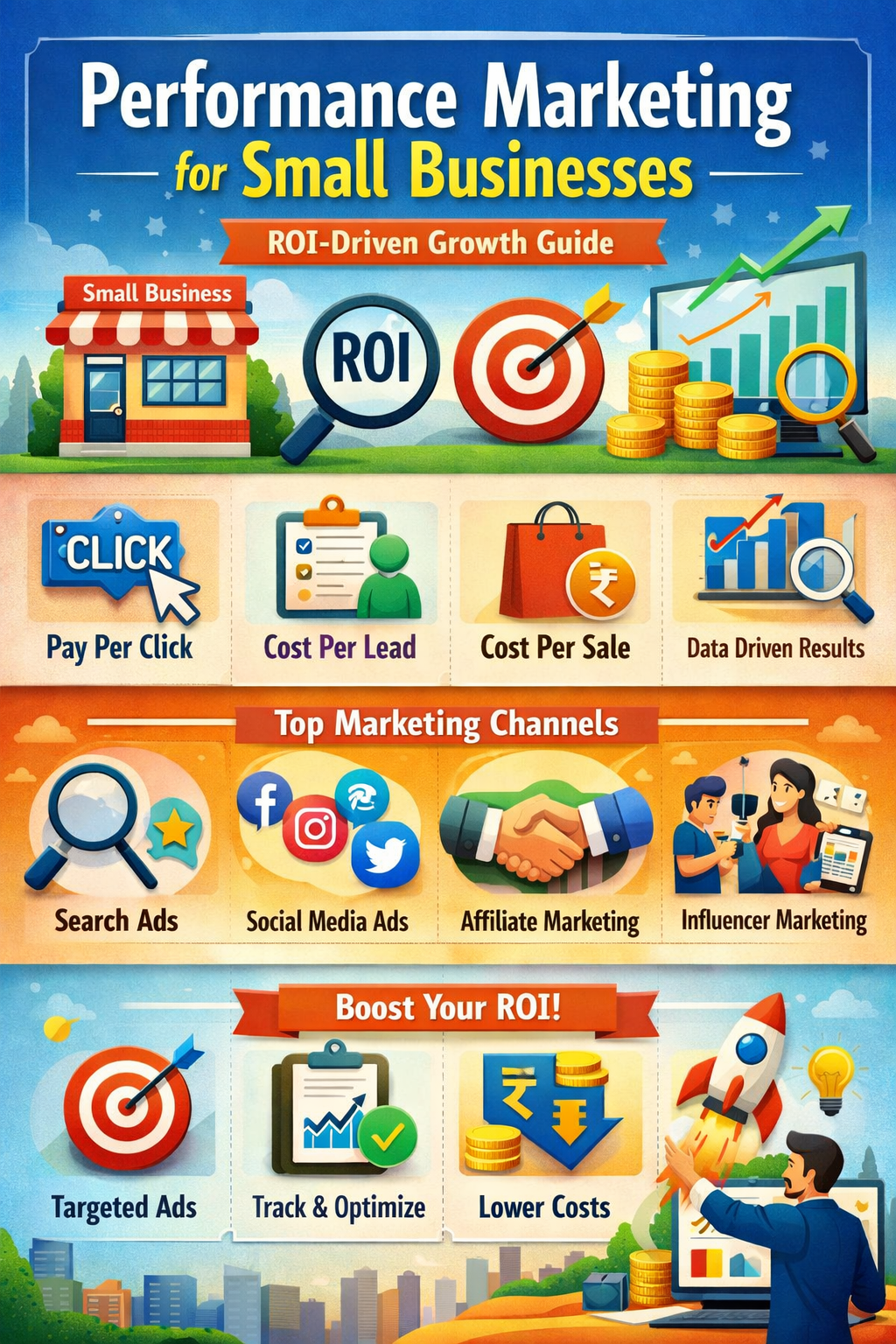
Introduction
For small businesses, every
marketing rupee matters. Unlike large corporations with massive budgets, small
businesses must ensure that every marketing effort delivers measurable results.
This is why Return on Investment (ROI) plays a critical role in
marketing decisions.
Traditional marketing
methods such as newspaper ads, billboards, and television commercials often
require high investments without guaranteed results. Small businesses
frequently struggle with limited budgets, uncertain outcomes, and difficulty
tracking the effectiveness of their campaigns.
This is where performance
marketing becomes a game-changer. Performance marketing is a results-driven
approach where businesses pay only when specific actions occur—such as clicks,
leads, or sales.
In this guide, you will
learn what performance marketing is, how it works, the best channels to use,
important metrics to track, and practical steps to start implementing it for
your small business.
What is Performance Marketing?
- Performance marketing is a
digital marketing strategy where advertisers pay only for measurable results.
Instead of paying for ad placement alone, businesses pay when a user performs a
desired action. These actions may include:
- A. Clicking on an
advertisement
B. Filling out a lead form
C. Signing up for a service
D. Purchasing a product
How It Differs from Traditional Marketing
Traditional marketing
focuses more on brand visibility and reach, but it is often difficult to
measure the direct impact on sales. Performance marketing, on the other hand,
emphasizes data, analytics, and measurable outcomes.
Why It’s Ideal for Small Businesses
Performance marketing is
especially beneficial for small businesses because it:
A.Reduces financial risk
B.Provides measurable
results
C.Allows precise audience
targeting
D.Enables businesses to
scale campaigns based on performance
This makes it a highly
efficient marketing approach for companies looking to maximize ROI.
How Performance Marketing Works
Performance marketing
follows a simple but effective model involving multiple participants.
Key Components
Advertiser
(Business Owner) : The business that wants to promote its products or services.
Marketing
Platforms : Digital platforms where ads are displayed, such as search engines and social
media platforms.
Publishers
or Advertising Networks : These distribute the ads across websites, apps, or other platforms.
Customers : The target audience who interact with the ads and take the desired action.
Common Payment Models
Cost Per
Click (CPC) : Businesses pay each time someone clicks on their ad.
Cost Per
Lead (CPL) : Payment occurs when a user submits a form or becomes a lead.
Cost Per
Acquisition (CPA) : Businesses pay only when a specific action, such as a sale, is completed.
Cost Per
Impression (CPM) : Payment is based on the number of times an ad is displayed.
Each model allows businesses
to choose the pricing structure that best fits their marketing objectives.
Key Performance Marketing Channels for Small
Businesses
1. Search Engine Advertising : Search engine advertising
allows businesses to display ads when users search for relevant keywords. These
ads target users who already have purchase intent, making them highly effective
for generating leads and sales.
2. Social Media Advertising : Social media platforms
provide powerful targeting options based on user interests, behavior, and
demographics. Businesses can run highly targeted campaigns to reach specific
customer segments.
3. Affiliate Marketing : Affiliate marketing involves
partnering with individuals or companies who promote your products. Affiliates
earn a commission when they generate leads or sales for your business.
4. Native Advertising : Native ads blend naturally
into website content, making them less intrusive and more engaging for users.
5 Influencer Marketing : Small businesses can
collaborate with micro-influencers who promote products to their
followers. Performance-based influencer campaigns often pay based on
conversions or engagement.
Benefits of Performance Marketing for Small
Businesses
Performance marketing offers
several advantages:
1.Pay only for measurable
results
2.Better control over
marketing budgets
3.Highly targeted audience
reach
4.Real-time campaign
tracking and analytics
5.Faster scaling
opportunities when campaigns perform well
Because results are
measurable, businesses can quickly adjust strategies to improve performance.
Key Metrics to Track in Performance Marketing
Tracking the right metrics
is essential for evaluating campaign success.
Click-Through
Rate (CTR) : Measures how many people click on an ad after seeing it.
Cost Per
Click (CPC) : The amount paid for each ad click.
Conversion
Rate
The percentage of users who complete a desired action.
Cost Per
Acquisition (CPA) : The cost required to acquire a customer.
Return on
Ad Spend (ROAS) : Measures the revenue generated for every rupee spent on ads.
Customer
Lifetime Value (CLV) : The total revenue a business can expect from a customer over time.
Step-by-Step Guide to Start Performance Marketing
Define Your Business Goals : Start by identifying what
you want to achieve—lead generation, sales growth, or brand awareness.
Identify Your Target Audience : Understand your ideal
customers based on demographics, interests, and online behavior.
Choose the Right Marketing Channels : Select advertising platforms
that match your business type and audience preferences.
Create High-Converting Ads and Landing
Pages : Use compelling ad copy,
engaging visuals, and optimized landing pages to increase conversions.
Set a Budget and Bidding Strategy : Start with a manageable
budget and adjust bids based on campaign performance.
Track and Optimize Campaign Performance : Use analytics tools to
monitor results and continuously improve your campaigns.
Common Performance Marketing Mistakes to Avoid
Small businesses should
avoid these common mistakes:
A.Targeting the wrong
audience
B.Not setting up conversion
tracking
C.Ignoring landing page
optimization
D.Stopping campaigns too
early
E.Failing to test multiple
ad variations
Continuous testing and
optimization are key to successful performance marketing.
Useful Performance Marketing Tools
Small businesses can use
various tools to improve campaign performance:
A.Advertising platforms for
running campaigns
B.Analytics tools for
tracking results
C.Landing page builders for
optimized conversions
D.Marketing automation tools
for lead nurturing
These tools help businesses
manage campaigns efficiently and improve ROI.
Real-Life Example of Performance Marketing Success
Consider a small online
clothing store that started running targeted social media ads. By focusing on a
specific audience segment and optimizing their landing page, the business
increased website traffic and generated more qualified leads.
Within a few months, the
company improved its conversion rate and significantly increased online sales
while keeping advertising costs under control.
Future Trends in Performance Marketing
Performance marketing
continues to evolve with technology. Some emerging trends include:
A.AI-powered
ad optimization for better
targeting
B.Automation
and smart bidding strategies
C.Personalized
advertising experiences
D.Privacy-focused
marketing strategies
Businesses that adapt to
these trends will gain a competitive advantage.
Conclusion
Performance marketing offers
a powerful solution for small businesses looking to maximize their marketing
ROI. By focusing on measurable results, targeted audiences, and data-driven
strategies, businesses can run cost-effective campaigns that deliver real
growth. The best approach is to
start small, test different strategies, and gradually scale campaigns based on
performance.
With the right tools,
strategies, and continuous optimization, performance marketing can become one
of the most effective growth engines for small businesses in today’s digital
world.