Introduction
In today’s digital era,
having a professional website is no longer optional — it’s essential. Your
website is often the first impression potential customers have of your
business. With increasing online competition across industries, a poorly
designed or slow website can cost you valuable leads and sales.
When building a website,
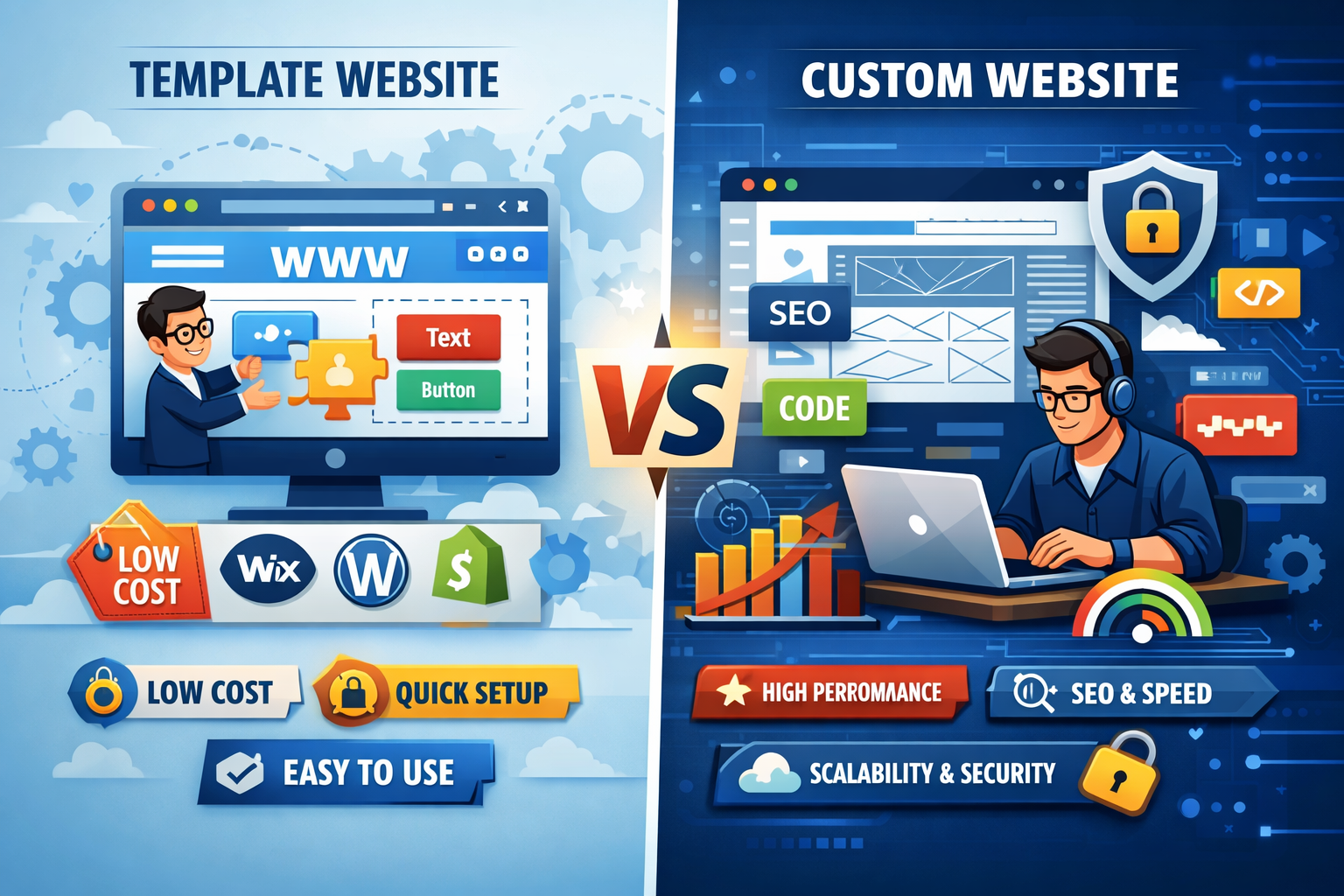
most businesses face a common dilemma: Should you choose a template website
or invest in a custom-built website? Both options have their advantages and
limitations. In this guide, you’ll learn the key differences, pros and cons,
cost comparisons, and which option works best for different types of
businesses.
What is a Template Website?
A template website is built
using pre-designed layouts provided by platforms such as Wix, Shopify,
and WordPress themes. These platforms offer ready-made designs that you
can customize using drag-and-drop builders.
Instead of building
everything from scratch, users simply edit text, replace images, change colors,
and publish the site. No coding knowledge is required.
Who Should Consider Template Websites?
1.Small businesses with
limited budgets
2.Startups launching quickly
3.Individuals or freelancers
4.Businesses with simple
website needs
Pros of Template Websites
1.Lower Initial Cost – Templates are affordable compared to custom
development.
2.Quick Setup – You can launch a website within days.
3.Beginner-Friendly – Easy drag-and-drop interface.
4.No Coding Required – Ideal for non-technical users.
Cons of Template Websites
1.Limited Customization – You are restricted to the template
structure.
2.Generic Design – Many other businesses may use the same
layout.
3.Performance Limitations – Templates often include unnecessary code
that slows down the site.
4.Scalability Issues – Adding advanced features later can be
challenging.
What is a Custom Website?
A custom website is designed
and developed from scratch according to your specific business needs.
Developers create unique layouts, tailored UI/UX designs, and custom
functionalities.
Unlike templates, custom
websites are fully aligned with your brand identity and long-term goals.
Pros of Custom Websites
1.Unique Branding – 100% customized design that reflects your
brand identity.
2.High Performance & Speed Optimization – Clean, optimized code improves loading
speed.
3.Better SEO Structure – Developers can build proper technical SEO
architecture.
4.Scalable & Future-Ready – Easy to add features as your business
grows.
5.Advanced Integrations – CRM, payment gateways, APIs, and automation
tools can be seamlessly integrated.
Cons of Custom Websites
1.Higher Upfront Cost – Initial investment is significantly higher.
2.Longer Development Time – It may take weeks or months to complete.
3.Requires Professional Developers – You need technical expertise.
Key Differences: Custom vs Template Website
1.Design & Branding
A.Template: Uses pre-made designs with limited
flexibility.
B.Custom: Designed completely around your brand’s
identity, tone, and goals.
If branding and uniqueness
are priorities, custom wins.
2.Cost Comparison
Templates require lower
initial investment. However, over time, hidden costs such as premium themes,
plugins, redesigns, and performance fixes may add up.
Custom websites require
higher upfront investment but often provide better long-term ROI due to
performance, scalability, and branding advantages.
3. SEO & Performance
Custom websites allow
developers to:
1.Optimize code structure
2.Improve loading speed
3.Implement technical SEO
best practices
4.Create clean URL
architecture
Template websites may limit
deep SEO customization and often carry bloated code.
4. Scalability & Flexibility
As businesses grow, they
need:
1.Advanced features
2.Custom dashboards
3.Integrations
4.Automation tools
Templates may struggle with
complex requirements, while custom websites are built with growth in mind.
5.Security
Template websites share
common frameworks. If a vulnerability is found in the theme or plugin, many
sites can be affected.
Custom websites allow for
tailored security measures and fewer shared vulnerabilities.
Which Option is Best for Different Types of
Businesses?
Small Businesses & Startups
If budget is tight and you
need a quick online presence, a template website works well. It’s
cost-effective and easy to manage.
Growing Companies
As your brand matures,
customization becomes important. A custom website helps build credibility and
stronger brand identity.
E-commerce Businesses
Performance and conversion
rate matter heavily in e-commerce. Custom websites offer better speed
optimization, checkout customization, and advanced integrations.
Enterprises
Large businesses require
scalability, custom integrations, advanced security, and unique branding.
Custom development is the ideal solution.
Long-Term Cost Analysis
Hidden Costs of Templates
1.Paid plugins
2.Premium themes
3.Performance upgrades
4.Redesign expenses
Over time, these costs can
approach custom development pricing.
ROI of Custom Development
1.Better conversion rates
2.Stronger branding
3.Improved SEO rankings
4.Long-term scalability
Maintenance Comparison
Templates may require
frequent plugin updates. Custom websites require technical maintenance but
offer more control.
Real-World Example Scenario
Consider a startup that
launches using a template website to minimize costs. Initially, it works well.
However, as traffic increases and advanced features are needed, the template
becomes restrictive.
Eventually, the business
invests in a custom website to improve performance, branding, and scalability.
This transition often happens when companies shift from survival mode to growth
mode.
Final Verdict: What Should You Choose?
Here’s a simple decision
checklist:
1.Limited
budget & quick launch needed? → Template
2.Strong
branding & long-term growth focus? → Custom
3.Complex
functionality required? → Custom
4.Testing a
new idea? → Template
Upgrade from template to
custom when your business starts growing rapidly, facing performance issues, or
requiring advanced features.
Conclusion
Both template and custom
websites have their place. Template websites are affordable and fast to launch,
while custom websites offer superior branding, performance, and scalability.
The right choice depends on
your budget, business goals, and long-term vision. Before deciding, assess
where your business is today — and where you want it to be in the future.
If you’re serious about
building a strong digital presence, consider consulting professional web
development experts to choose the solution that aligns with your growth
strategy.