Introduction
“You’re
getting traffic… but where are the conversions?”
This is one of the most
common frustrations in digital marketing. You’re running ads, publishing
content, driving visitors to your website — yet sales or leads aren’t growing
the way you expected.
Often, the issue isn’t
traffic. It’s the conversion strategy.
This brings us to an
important debate: Landing Page vs Sales Funnel. Are they the same? Which
one converts better? And more importantly — which one is right for your
business?
In this guide, you’ll learn
the difference between landing pages and funnels, when to use each, and how to
combine both for maximum ROI.
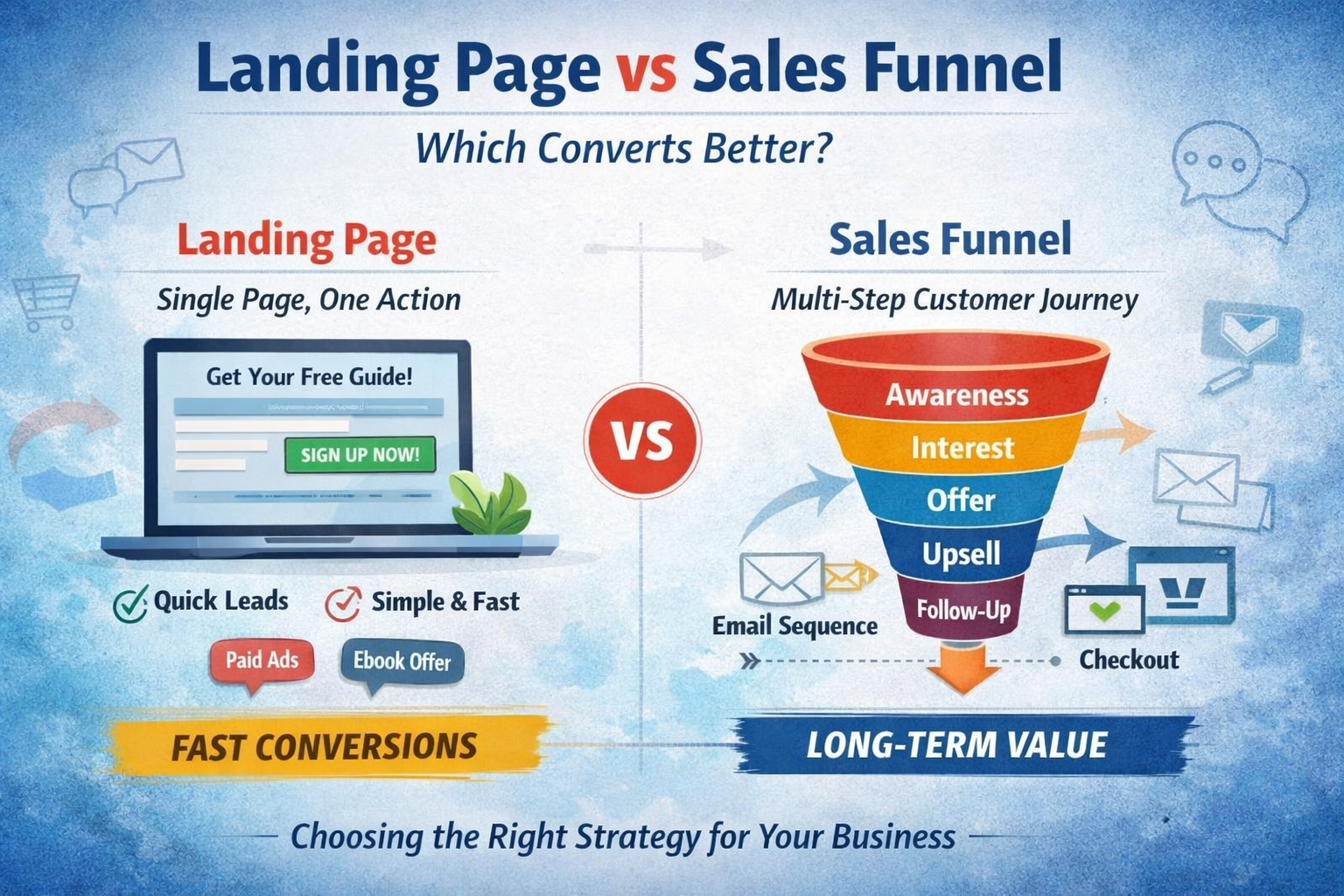
What is a Landing Page?
Simple Definition
A landing page is a
standalone web page designed for one specific goal — usually to capture a lead,
generate a signup, or drive a purchase.
Main Goal
Focus on one single
action.
Key Elements
1.Compelling headline
2.Clear and visible CTA
(Call-to-Action)
3.Minimal distractions (no
unnecessary navigation)
4.Social proof
(testimonials, reviews, trust badges)
Common Types
1. Lead Generation Landing Page – Collects emails or contact details.
2. Click-Through Landing Page – Warms up users before sending them to
checkout.
3. Sales Landing Page – Persuades visitors to buy directly.
Best Use Cases
Landing pages work best
when:
1.You need quick lead
capture
2.You’re running paid ads
3.You’re promoting a
limited-time offer
4.You want focused action
without distractions
They are simple, direct, and
highly effective for short decision cycles.
What is a Sales Funnel?
Definition
A sales funnel is a
multi-step process designed to guide a potential customer from awareness to
purchase — and beyond.
Unlike a landing page, a
funnel doesn’t rely on one page. It’s a structured journey.
Stages of a Funnel
1. Awareness
2. Interest
3. Consideration
4. Conversion
5. Follow-up / Upsell
Components
1.Landing pages
2.Email automation sequences
3.Checkout pages
4.Upsell and downsell pages
How Funnels Guide Psychology
Funnels work by gradually
building trust and addressing objections step-by-step. Instead of asking for an
immediate purchase, they nurture the customer.
This structured journey
aligns with buyer psychology — especially for high-ticket or complex offers.
Key Differences Between Landing Page and Funnel
Structure:
Landing pages focus on one page. Funnels involve multiple interconnected steps.
Goal:
Landing pages drive one decision. Funnels manage the entire buying journey.
Complexity:
Landing pages are easy to build. Funnels require planning and automation.
Automation:
Funnels often use email sequences and retargeting. Landing pages usually don’t.
Customer
Journey:
Landing pages work for fast decisions. Funnels nurture longer decision cycles.
Which One Converts Better? (Data-Driven
Perspective)
Conversion rate benchmarks
vary, but:
1.Average landing page
conversion: 5–10%
2.Well-optimized funnels: 10–20%+
overall journey conversion
When Landing Pages Convert Better
1.Low-cost products
2.High buyer intent traffic
3.Limited-time offers
4.Simple lead magnets
When Funnels Outperform
1.High-ticket services
2.Coaching and consulting
3.Online courses
4.Products requiring
trust-building
Traffic Source Impact
A.Paid Ads: Landing pages work well for quick
conversions.
B.Organic
Traffic: Funnels help nurture cold
audiences.
C.Email
Marketing: Funnels
dramatically increase lifetime value.
Buyer Intent Matters
If the audience already
wants what you offer, a landing page may be enough.
If they need education and trust-building, a funnel wins.
When to Use a Landing Page
Use a landing page if you
are:
1.Running paid ads for quick
lead capture
2.Promoting a webinar
3.Offering a free ebook or
checklist
4.Launching a limited-time
discount
5.An early-stage startup
testing demand
Landing pages are ideal for
speed and simplicity.
When to Use a Funnel
Choose a funnel when you
have:
1.High-ticket products or
services
2.Online courses
3.Coaching or consulting
programs
4.E-commerce upsell
opportunities
5.Long sales cycles
Funnels maximize customer
lifetime value through nurturing and upselling.
Can You Use Both Together? (Smart Strategy)
Absolutely.
In fact, landing pages are
often part of a funnel.
Example Structure:
Ad → Landing Page → Thank
You Page → Email Sequence → Offer → Upsell
This hybrid strategy
captures attention quickly and then nurtures leads strategically.
Combining both increases ROI
because you optimize both immediate conversions and long-term value.
Common Mistakes to Avoid
1.Sending paid traffic to
your homepage
2.Overcomplicating funnels
3.Having no clear CTA
4.Ignoring follow-up emails
5.Not tracking analytics
Clarity and tracking are
critical for optimization.
How to Decide for Your Business (Decision
Framework)
Ask yourself:
1.What is your product price?
2.How aware is your audience?
3.Do they need nurturing?
4.What is your traffic source?
5.What is your budget?
Simple Decision Tree:
1.Low price + warm audience
→ Landing Page
2.High price + cold audience
→ Funnel
3.Limited budget → Start
with Landing Page
4.Long-term growth focus →
Funnel
Start simple, then scale
strategically.
Tools to Build Landing Pages and Funnels
Landing Page Builders
A.Unbounce
B.Instapage
C.Leadpages
Funnel Builders
A.ClickFunnels
B.Kartra
C.Systeme.io
Email Automation
A.Mailchimp
B.ActiveCampaign
Analytics
A.Google Analytics
Conclusion
Landing pages and funnels
serve different purposes.
A landing page focuses on
one action.
A funnel manages the entire customer journey.
The real question isn’t “Which
is better?”
It’s “Which is right for your goal?”
Start by auditing your
current strategy.
Test one approach. Measure results. Optimize continuously.
Because in digital
marketing, strategy — not traffic — determines conversions.