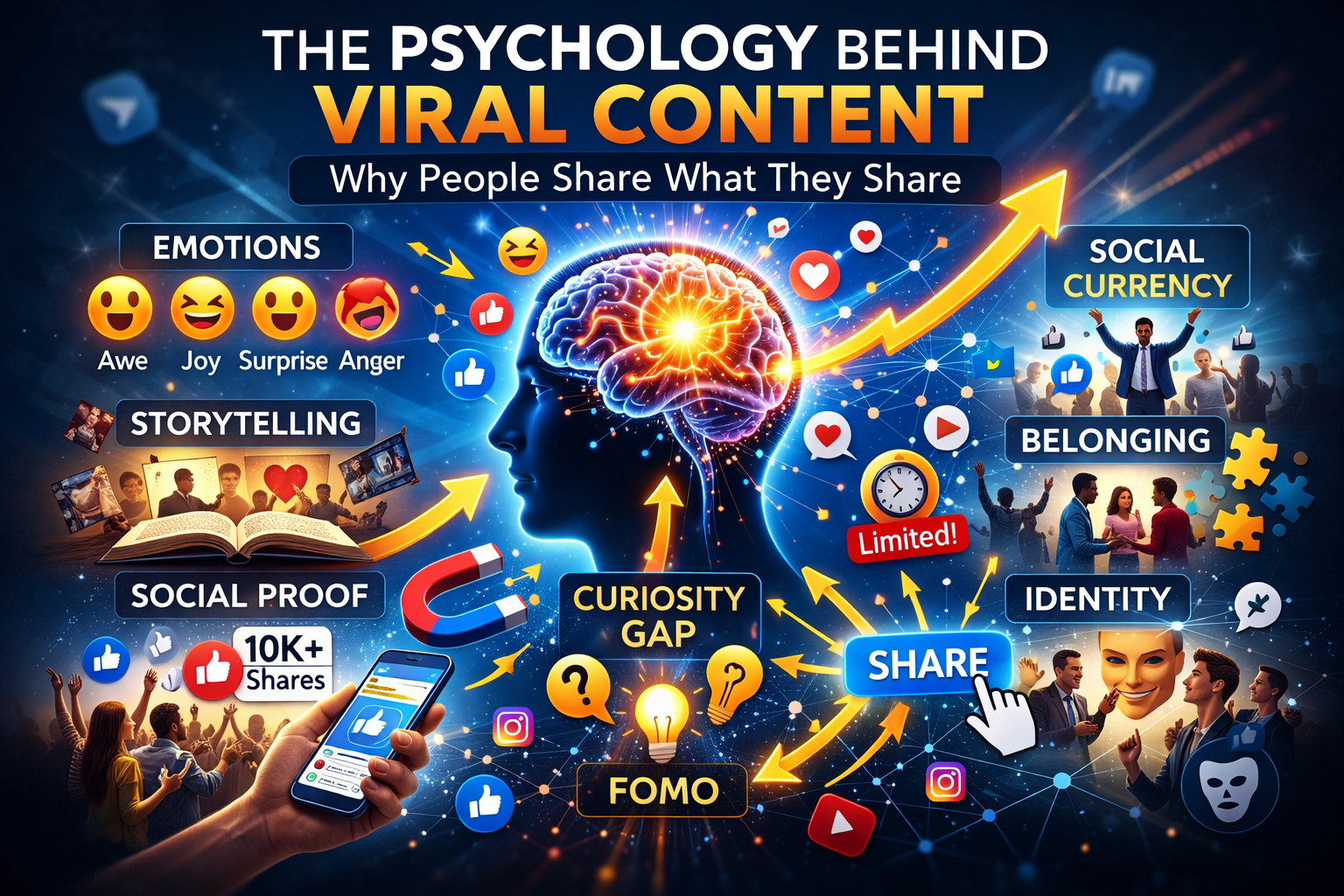
Introduction:
What Makes Content Go Viral?
In the digital world, “going
viral” is often seen as a stroke of luck. But in reality, viral marketing is
far from random. Viral marketing refers to content that spreads rapidly
from person to person through shares, reposts, and conversations—much like a
virus spread biologically.
The truth is, virality isn’t
about chance. It’s about psychology.
Every share, like, and
comment is rooted in human behavior. People don’t share content just because it
exists—they share it because it makes them feel something or say
something about themselves. Understanding why humans are wired to share gives
marketers, creators, and brands a powerful competitive edge.
In this article, we’ll
explore the psychological triggers behind viral content—from emotional
intensity and social proof to storytelling and identity signaling—and provide a
practical framework to apply them effectively.
Understanding the Science of Sharing
A. The Social Currency Principle
People share content that
enhances how others perceive them. Psychologists call this social currency—the
value we gain when we share something interesting, insightful, funny, or
exclusive.
When someone shares a clever
infographic, a thought-provoking article, or a hilarious reel, they’re
indirectly saying:
“I’m smart.”
“I’m funny.”
“I’m informed.”
Sharing builds personal
branding. It shapes how others see us in digital spaces. Brands that understand
this create content that makes their audience look good for sharing it.
B. The Need for Belonging
Humans are biologically
wired for connection. Sharing content creates a sense of belonging. It’s a
digital way of saying, “This is my tribe.”
Community-driven virality
happens when people feel emotionally connected to a message. Movements, trends,
and social causes spread rapidly because they give individuals a sense of
inclusion and identity.
Emotional Triggers That Drive Virality
A. High-Arousal Emotions
Research shows that high-arousal
emotions significantly increase sharing behavior. These include:
1.Awe
2.Excitement
3.Anger
4.Fear
5.Surprise
Why? Because intense
emotions activate the nervous system. When something makes our heart beat
faster or gives us goosebumps, we feel compelled to react—and sharing is one of
the quickest reactions online.
Content that sparks awe
(“This is unbelievable!”) or anger (“This is outrageous!”) spreads faster than
neutral information.
B. Positive vs. Negative Emotions
Positive emotions—like
inspiration, joy, and hope—often lead to broader, longer-lasting sharing.
Inspirational stories, motivational content, and uplifting messages create safe
and rewarding experiences for audiences.
However, controversial or
negative content can also go viral—especially when it taps into outrage or
injustice. The key is emotional intensity, not just positivity.
C. FOMO (Fear of Missing Out)
Scarcity psychology plays a
powerful role in digital sharing. Limited-time offers, trending topics, and
exclusive information trigger FOMO—the fear of being left out.
When people believe
information is scarce or time-sensitive, they are more likely to engage and
share it quickly. Urgency fuels virality.
The Power of Storytelling in Viral Marketing
Stories activate multiple
areas of the brain, making them more memorable than plain facts. Neuroscience
shows that storytelling triggers empathy and emotional connection, which
increases shareability.
Relatable, character-driven
narratives allow audiences to see themselves in the story. When people identify
with a character’s struggle or success, they feel personally involved.
A simple viral story
structure often includes:
1. A relatable character
2. A clear problem
3. Emotional tension
4. A turning point
5. A satisfying resolution
This emotional arc keeps
attention high and encourages sharing because the audience experiences the
journey, not just the message.
Social Proof & Herd Mentality
Humans look to others for
cues on what’s important. This is called social proof.
When people see that
“everyone is watching this,” they assume it must be valuable. Likes, shares,
comments, and views act as digital validation signals.
Influencers amplify this
effect. When respected figures endorse content, it triggers herd mentality—also
known as the bandwagon effect. People trust what others already trust.
Social proof reduces
uncertainty, making sharing feel safer and more justified.
The Curiosity Gap: Why Clickable Content Works
The curiosity gap is
the psychological space between what we know and what we want to know.
Headlines like:
A.“You Won’t Believe What
Happened Next…”
B.“7 Mistakes That Are
Killing Your Growth”
create open loops in the
brain. Our minds crave closure. We click to resolve the tension.
However, ethical content
delivers on the promise. Clickbait, on the other hand, creates curiosity but
fails to satisfy it—damaging trust long term. Sustainable virality balances
intrigue with value.
Identity & Self-Expression
Sharing is a form of
identity signaling.
People share content that
reflects their values, beliefs, humor, and aspirations. Tribe-based marketing
works because it taps into this instinct. When content speaks directly to a
niche community, micro-virality often follows.
Niche audiences are highly
engaged. They don’t just consume—they advocate.
When your content aligns
with your audience’s identity, sharing becomes automatic.
Practical Framework: Applying Psychology to Create
Viral Content
Here’s a step-by-step
framework:
1. Define your audience’s emotional landscape
What excites them? What frustrates them?
2. Choose one strong emotional trigger
Don’t dilute your message with multiple competing emotions.
3. Craft a compelling hook (First 3 Seconds Rule)
Attention is fragile. Capture it instantly.
4. Add social proof elements
Testimonials, engagement stats, influencer mentions.
5. Make sharing effortless
Clear share buttons, short formats, mobile-friendly design.
6. Include a subtle call-to-action
Encourage sharing naturally, not forcefully.
Common Psychological Mistakes That Kill Virality
1.Being too promotional
2.Ignoring emotional depth
3.Overcomplicating the
message
4.Lacking relatability
5.Weak opening hooks
If your content feels like
an ad instead of a human experience, it won’t spread.
Conclusion:
Virality is Human Behavior, Not Just
Marketing
Viral content isn’t magic.
It’s psychology in action.
When you understand social
currency, emotional triggers, storytelling, social proof, curiosity gaps, and
identity signaling, you stop guessing—and start engineering shareability.
The ultimate truth?
People
don’t share content. They share feelings.
And the brands that master
human emotion will always win in the digital world.