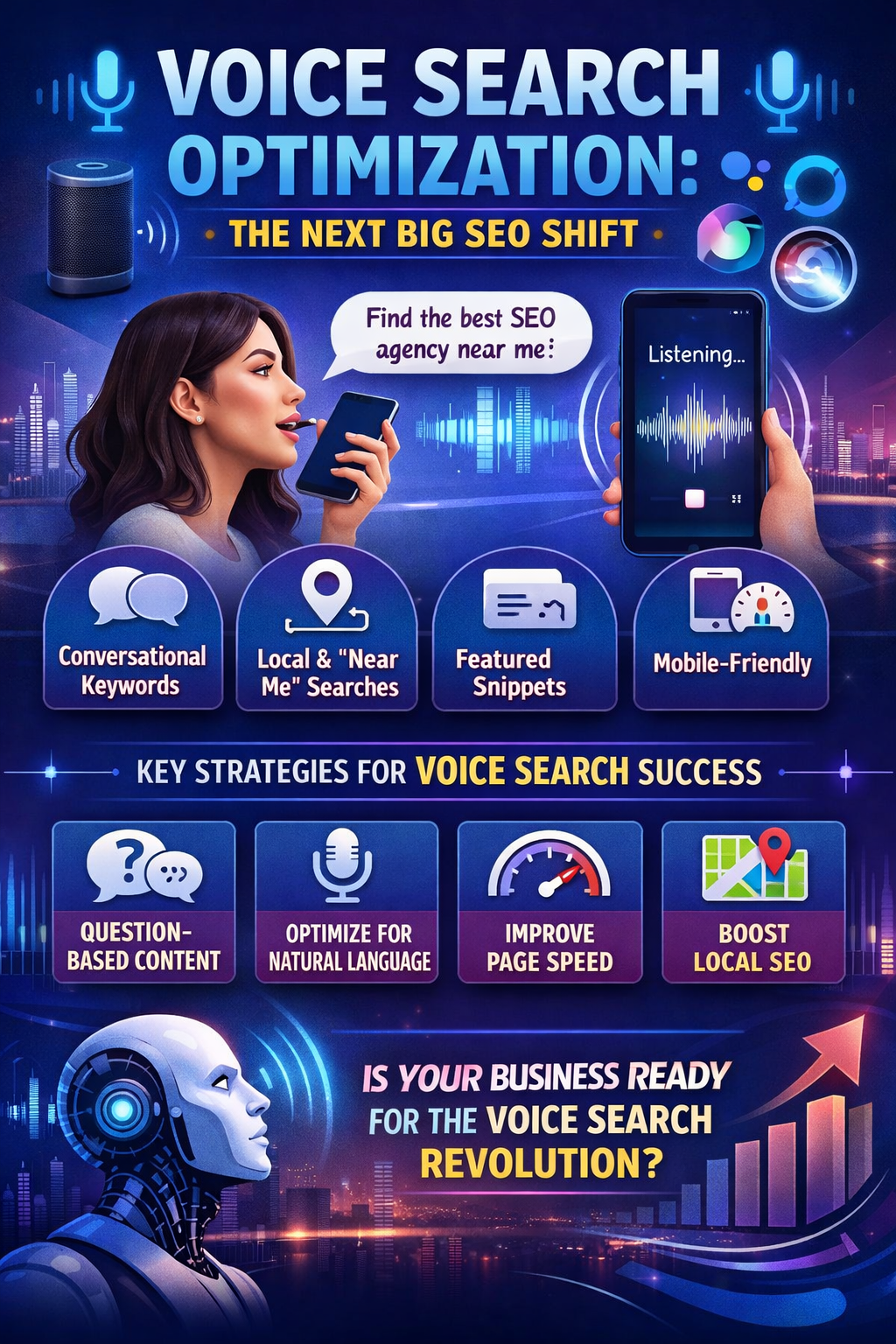
Introduction: The Way People Search Is Changing
“Hey Siri, find the best
digital marketing agency near me.”
“Ok Google, what’s the best SEO strategy for 2026?”
Search is no longer limited
to typing keywords into a browser. With the rise of voice assistants like Google
Assistant, Siri, and Amazon Alexa, users are increasingly speaking their
queries instead of typing them.
Voice search is transforming
how people interact with search engines — and it’s reshaping SEO strategies in
a big way. Businesses that fail to adapt risk losing visibility in this rapidly
evolving search landscape.
Let’s explore why voice
search optimization is the next big SEO shift and how you can prepare for it.
What Is Voice Search Optimization?
Voice Search Optimization
(VSO) is the process of optimizing your website and content so it appears in
results for voice-based queries.
Unlike traditional SEO,
voice search focuses on:
1.Conversational keywords
2.Natural language queries
3.Question-based search
phrases
4.Local and intent-driven
searches
Voice queries tend to be
longer and more specific.
For example:
1.Typed search: “best SEO
company Delhi”
2.Voice search: “Which is
the best SEO company in Delhi for small businesses?”
This shift from short
keywords to full-sentence queries is what makes voice search optimization
unique.
Why Voice Search Is Growing Rapidly
1.Increased Smartphone Usage
Smartphones have made voice
search incredibly accessible. With just a tap or wake word, users can instantly
ask questions.
2.Rise of Smart Speakers
Devices powered by Alexa and
Google Assistant are now common in homes, making voice interactions part of
daily life.
3.Faster & More Convenient
Speaking is faster than
typing. Users prefer voice search when driving, cooking, multitasking, or on
the go.
4.Improved AI & NLP
Search engines now use
advanced Natural Language Processing (NLP) to understand context, tone, and
user intent more accurately than ever.
How Voice Search Is Changing SEO
1.Conversational Keywords Matter More
Traditional SEO focused
heavily on short-tail and exact-match keywords. Voice search prioritizes
conversational, long-tail keywords.
Instead of optimizing for:
*“digital marketing
services”
You should optimize for:
*“What are the best digital
marketing services for startups?”
2.Featured Snippets Are Crucial
Voice assistants often read
answers from featured snippets (Position Zero). If your content ranks as a
featured snippet, it increases your chances of being the spoken answer.
To win snippets:
*Answer questions clearly
*Use bullet points
*Keep answers concise (40–60
words)
3.Local SEO Becomes Even More Important
Many voice searches are
local:
*“Best café near me”
*“Top web development
company in Mumbai”
Optimizing your Google
Business Profile, location keywords, and local citations is critical for voice
visibility.
4.Mobile Optimization Is Non-Negotiable
Most voice searches happen
on mobile devices. A slow or poorly optimized website can hurt your rankings
significantly.
Ensure:
*Fast loading speed
*Responsive design
*Clean, structured layout
Practical Strategies for Voice Search Optimization
Here’s how businesses can
adapt:
1.Focus on Question-Based Content
Create FAQ sections
addressing real user questions. Use tools like Google’s “People Also Ask” to
identify common queries.
Example:
*“What is voice search
optimization?”
*“How does voice search
affect SEO?”
2.Optimize for Natural Language
Write in a conversational
tone. Voice search is based on how people speak, not how they type.
Avoid robotic keyword
stuffing. Instead, use natural sentences that answer real questions.
3.Improve Page Speed
Voice users expect instant
results. Optimize images, use caching, and reduce unnecessary scripts to
improve performance.
4.Use Structured Data (Schema Markup)
Schema helps search engines
understand your content better. FAQ schema, local business schema, and review
schema improve your chances of appearing in rich results.
5.Strengthen Local SEO
*Update business listings
*Use location-specific
keywords
*Encourage customer reviews
This significantly boosts
visibility for “near me” voice searches.
The Role of AI in Voice Search
Voice search relies heavily
on AI-driven algorithms. Modern search engines interpret user intent rather
than just keywords.
For example:
If someone asks:
“Which SEO company is affordable and good for small businesses?”
Search engines analyze:
1.Intent (service-based)
2.Budget preference
(affordable)
3.Target audience (small
businesses)
Content that clearly
addresses these factors has a higher chance of ranking in voice results.
Challenges of Voice Search Optimization
While voice search offers
opportunities, it also presents challenges:
1.Fewer visible results
(often just one spoken answer)
2.Higher competition for
featured snippets
3.Increased importance of
domain authority
This makes high-quality,
well-structured content more important than ever.
The Future of Voice Search & SEO
Voice search is not a trend
— it’s a fundamental shift in search behavior. As AI becomes more advanced and
voice interfaces improve, spoken queries will become even more natural and
contextual.
In the coming years,
businesses that:
1.Focus on user intent
2.Optimize for
conversational content
3.Prioritize mobile
performance
4.Strengthen local SEO
…will dominate voice-driven
search results.
Conclusion
Voice Search Optimization is
redefining how SEO works. It moves beyond keywords and focuses on intent,
conversation, and real human language.
The brands that adapt early
will gain a competitive edge, higher visibility, and stronger engagement.
The question is no longer “Should
we optimize for voice search?”
It’s “How fast can we adapt to this next big SEO shift?”
If your SEO strategy still
revolves only around traditional keyword targeting, now is the time to evolve.
Voice is the future — and the future has already started.