Introduction
Mobile apps are no longer
optional — they are the backbone of modern businesses. From startups to global
enterprises, companies rely on apps to engage customers, streamline operations,
and generate revenue. In 2026, the app economy continues to grow at an
unprecedented pace, driven by digital transformation, AI innovation, and
changing consumer behavior.
With billions of smartphone
users worldwide, businesses must stay updated with emerging app development
trends to remain competitive. This article explores the current state of app
development in 2026, key trends shaping the industry, powerful technologies
behind it, monetization strategies, industry opportunities, and how businesses
can prepare for the future.
The State of App Development in 2026
A. Market Growth & Statistics
The global app market is
projected to cross trillions in revenue by 2026, fueled by subscriptions,
in-app purchases, and enterprise solutions. Enterprise app adoption is rapidly
increasing as organizations digitize workflows and adopt cloud-first strategies.
On-demand apps (like food
delivery, mobility, and home services) and SaaS-based mobile platforms are
seeing massive growth. Businesses now demand scalable, secure, and
performance-driven applications that support remote and hybrid ecosystems.
B. Changing User Expectations
Today’s users expect:
*Lightning-fast performance
*Seamless and intuitive UX
*Personalized content and
recommendations
*Strong privacy and data
security
Apps that fail to meet these
expectations struggle with retention and engagement. User experience is no
longer a luxury — it’s a necessity.
Top App Development Trends in 2026
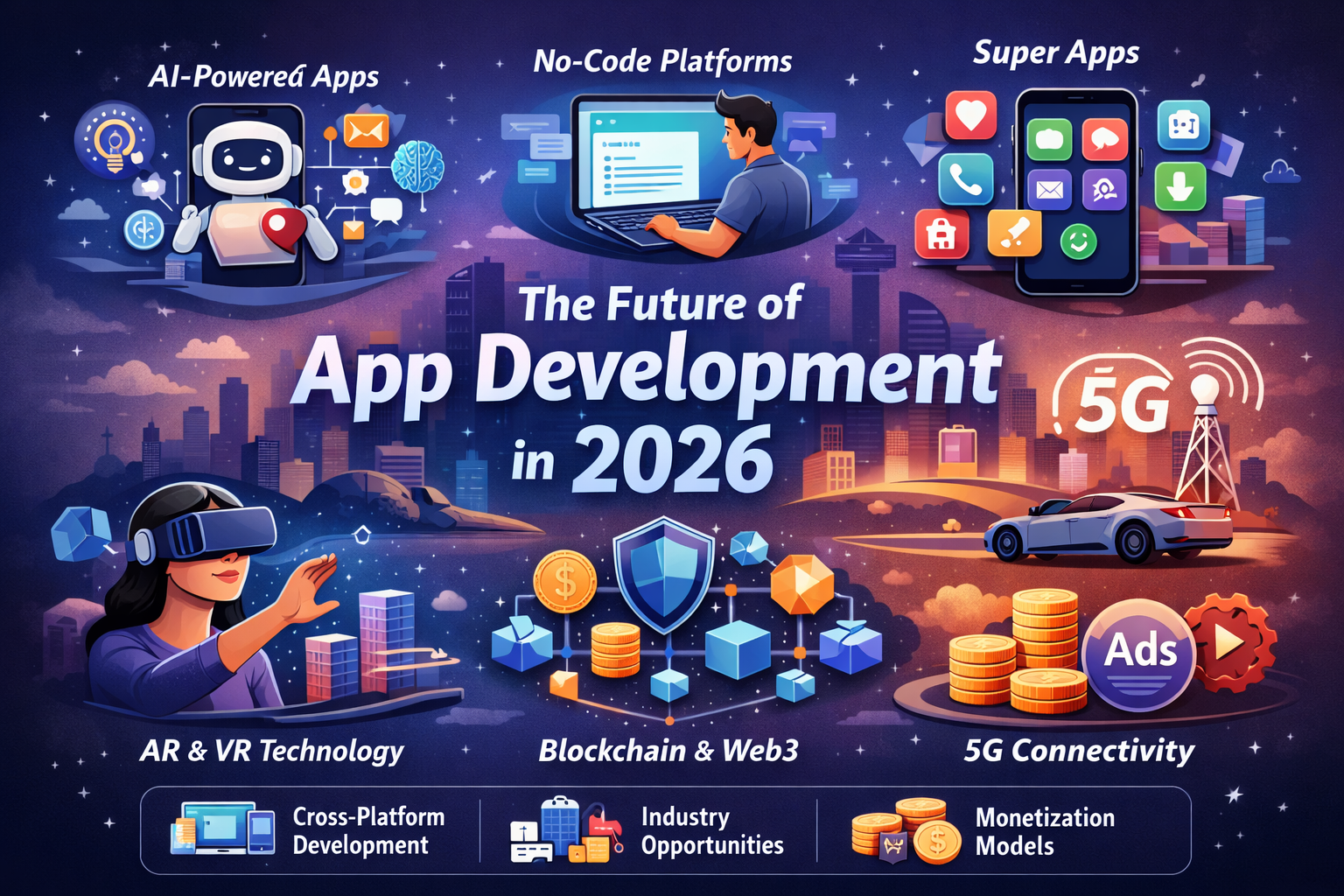
1. AI-Powered Applications
Artificial Intelligence is
at the center of app innovation. Platforms like OpenAI and Google continue
advancing AI integration in mobile apps.
AI-powered features include:
1.Smart chatbots for 24/7
support
2.Predictive analytics for
customer insights
3.Personalized
recommendations
4.AI-driven automation
AI-first apps are becoming
the new standard.
2. No-Code & Low-Code Development
Businesses now prioritize
speed-to-market. No-code and low-code platforms such as Bubble and Out Systems
enable rapid MVP launches and reduce development costs.
These platforms allow
startups and enterprises to prototype quickly, test ideas, and iterate faster
without heavy engineering resources.
3. Super Apps
Grab and WeChat pioneered
the “super app” model — combining payments, messaging, shopping, and services
into one ecosystem.
In 2026, more regions are
adopting this multi-service app approach to increase engagement and customer
lifetime value.
4. Cross-Platform Development
Businesses prefer one
codebase for multiple platforms to save time and cost. Frameworks like Flutter
and React Native deliver near-native performance with cross-platform
efficiency.
Benefits include:
1.Reduced development costs
2.Faster deployment
3.Easier maintenance
5. AR & VR Integration
Augmented Reality and
Virtual Reality are transforming industries:
1.Retail apps offer virtual
try-ons
2.Real estate apps provide
immersive property tours
3.Education and corporate
training use VR simulations
As devices improve, AR/VR
adoption will accelerate further.
6. Blockchain-Based Apps
Blockchain is enhancing
transparency and security. Decentralized apps (dApps) built on networks like Ethereum
enable secure transactions and Web3 integrations.
Use cases include:
1.Secure fintech
transactions
2.NFT marketplaces
3.Decentralized identity
verification
7. 5G-Powered Applications
With global 5G expansion,
apps now support:
1.Real-time multiplayer
gaming
2.HD and 4K video streaming
3.IoT-based smart
applications
Faster connectivity means
richer, more immersive app experiences.
Technologies Powering App Development in 2026
Programming Languages
Modern mobile-friendly
languages like Kotlin, Swift, Dart, and TypeScript dominate app development due
to performance and scalability.
Frameworks & Tools
Cross-platform frameworks
such as Flutter and React Native remain popular. Backend technologies include
Node.js and cloud-native architectures powered by AWS, Azure, and Google Cloud.
DevOps & Automation
CI/CD pipelines, automated
testing, and DevOps practices reduce deployment cycles and improve software
reliability.
Industry-Wise Opportunities in 2026
1.Healthcare
Apps: Telemedicine platforms and
AI-based diagnostics
2.Fintech
Apps: Digital wallets and
AI-driven investment tools
3.EdTech
Apps: AI tutors and skill-based
learning platforms
4.E-commerce
& D2C Apps:
Personalization engines and one-click checkout
5.Logistics
& On-Demand Apps: Real-time
tracking and route optimization
Digital transformation is
opening massive industry-specific app opportunities.
Monetization Models for Apps in 2026
Businesses are diversifying
revenue streams through:
1.Subscription-based models
2.Freemium strategies
3.In-app purchases
4.Ad-based monetization
5.Marketplace commissions
Hybrid monetization
strategies are becoming increasingly common.
Challenges in App Development (And Solutions)
1.Security
Risks – Implement encryption,
regular audits, and compliance measures.
2. High Competition – Focus on niche targeting and unique value
propositions.
User Retention Issues – Prioritize UX, personalization, and push
notification strategies.
3. Budget Constraints – Start with MVP development and scale gradually.
App Store Optimization (ASO) – Optimize keywords, visuals, and ratings
to increase visibility.
Future Scope: Beyond 2026
The next phase of app
development will focus on:
1.AI-first ecosystems
2.Voice- and
gesture-controlled apps
3.Wearable tech integration
4.Hyper-personalized user
journeys
Apps will become smarter,
faster, and more predictive.
How Businesses Can Prepare for 2026
1.Validate ideas before
development
2.Choose the right tech
stack
3.Prioritize UX and
performance
4.Invest in ASO and digital
marketing
5.Partner with experienced
development teams
Early adopters will gain a
strong competitive advantage.
Conclusion
App development in 2026 is
driven by AI, automation, cross-platform innovation, and user-centric design.
Businesses that embrace emerging technologies like AI, blockchain, AR/VR, and
5G will thrive in the competitive digital landscape.
Innovation is no longer
optional — it’s essential. Now is the best time to invest in app development
and build scalable, future-ready digital solutions that meet evolving user
expectations.