Introduction
In digital marketing, a
landing page is a standalone web page created specifically to convert visitors
into leads or customers. Unlike regular website pages, landing pages focus on
one goal — whether it’s collecting email signups, generating leads, or driving
product purchases.
Landing page optimization is
critical because even small improvements in conversion rate can significantly
increase revenue without increasing ad spend. Poorly optimized landing pages
waste traffic, increase customer acquisition costs, and reduce overall
marketing ROI. Businesses often spend thousands on ads but lose potential
customers due to simple landing page mistakes.
In this article, you will
learn the top 10 landing page mistakes that reduce conversions — along with
practical, easy-to-apply fixes.
What is a High-Converting Landing Page?
A high-converting landing
page is designed with clarity, focus, and user psychology in mind. It usually
includes:
1.One clear goal or
objective
2.A strong and clear value
proposition
3.One focused Call-to-Action
(CTA)
4.Trust-building elements
like testimonials and security badges
5.Fast loading speed and
mobile optimization
When these elements work
together, they create a smooth user journey that encourages visitors to take
action.
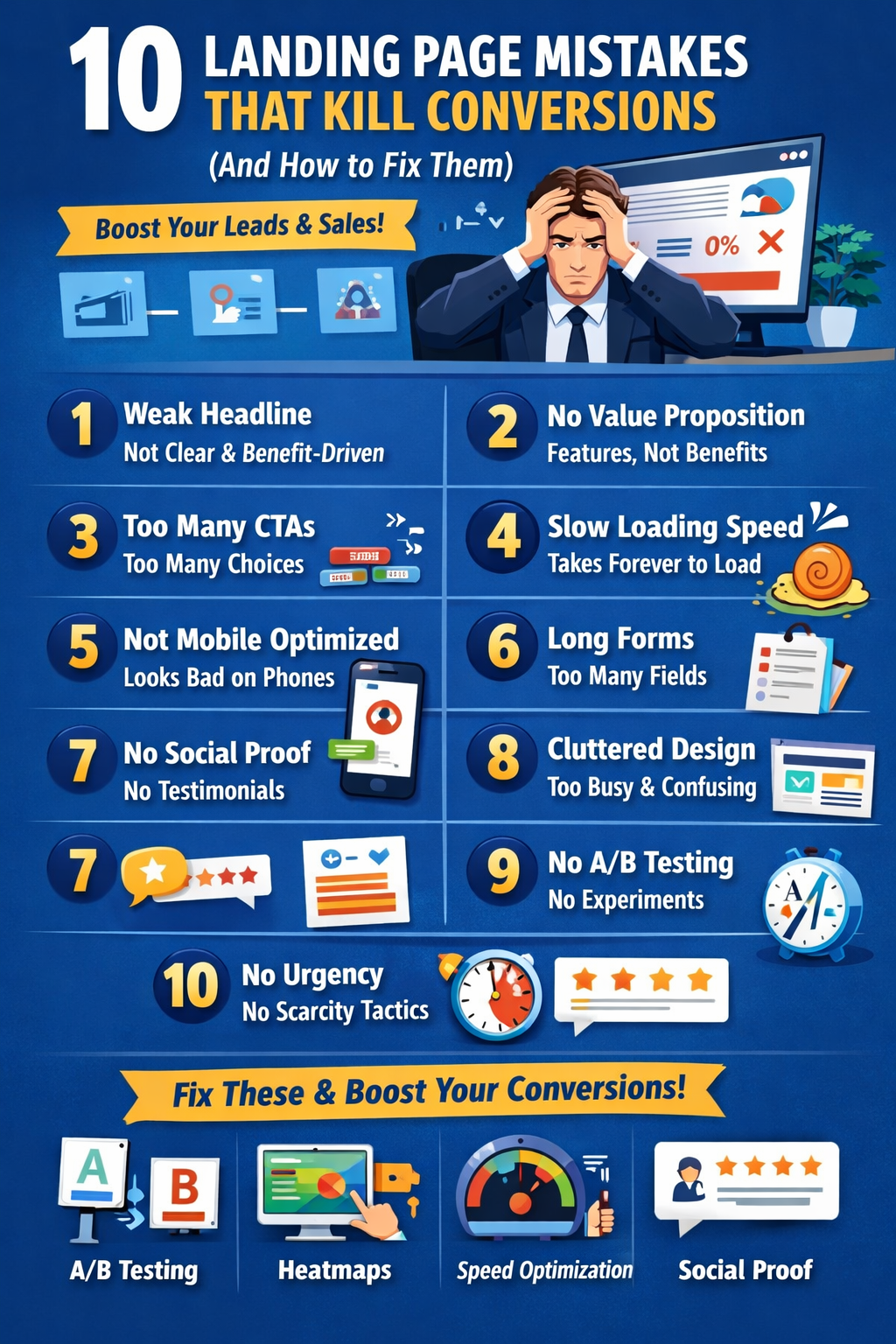
10 Landing
Page Mistakes That Kill Conversions
1.Weak or Confusing Headline
Problem:
Visitors don’t understand your offer within 5 seconds.
Why It
Hurts Conversions:
This increases bounce rate and reduces engagement.
How to Fix
It:
Use a clear, benefit-driven headline. Add numbers and strong words.
Example:
Before — “Best Marketing Solutions”
After — “Increase Your Leads by 40% in 30 Days”
2.No Clear Value Proposition
Problem:
Many pages talk about product features instead of benefits.
Why It
Hurts:
Visitors don’t understand why they should care.
How to Fix:
Focus on outcomes and transformation.
Answer the visitor’s main question: “What’s in it for me?”
Add a supporting sub-headline explaining the result.
3.Too Many Call-To-Actions (CTAs)
Problem:
Multiple buttons like Buy Now, Contact Us, Learn More, Subscribe.
Why It
Hurts:
Creates confusion and decision fatigue.
How to Fix:
Use one primary CTA.
Add a secondary CTA only if necessary.
Use contrasting button colors to highlight action.
4.Slow Page Loading Speed
Problem:
Heavy images, poor hosting, and unoptimized scripts.
Why It
Hurts:
Visitors leave quickly. It also affects search rankings.
How to Fix:
Compress images, enable caching, and optimize hosting and scripts.
5.Not Mobile Optimized
Problem:
Landing page layout breaks on smartphones.
Why It
Hurts:
Most users browse from mobile devices.
How to Fix:
Use responsive design.
Make buttons thumb-friendly.
Use shorter forms for mobile users.
6.Long and Complicated Forms
Problem:
Asking for too much information upfront.
Why It
Hurts:
Creates friction and reduces form submissions.
How to Fix:
Reduce form fields.
Use multi-step forms.
Ask only essential information initially.
7.Lack of Social Proof
Problem:
No testimonials, reviews, or real customer proof.
Why It
Hurts:
Visitors don’t trust the offer.
How to Fix:
Add customer testimonials.
Show ratings and reviews.
Include client logos and case studies.
8.Poor Visual Hierarchy and Cluttered Design
Problem:
Too much text and poor structure.
Why It
Hurts:
Overwhelms visitors and reduces readability.
How to Fix:
Use white space effectively.
Break text into bullet points.
Follow natural reading patterns like F-pattern layout.
9.No A/B Testing
Problem:
Making decisions based on assumptions.
Why It
Hurts:
Misses opportunities for improvement.
How to Fix:
Test different headlines, CTA colors, and layouts.
Use analytics and heatmaps to understand user behavior.
10.No Urgency or Scarcity Trigger
Problem:
No reason for visitors to act immediately.
Why It
Hurts:
Users delay decisions and forget later.
How to Fix:
Use limited-time offers.
Add countdown timers.
Highlight limited seats or stock availability.
Bonus: Psychological Triggers That Boost
Conversions
High-performing landing
pages often use psychological principles such as:
1.Reciprocity – Offering free value first
2.Authority – Showing certifications or expert
endorsements
3.Scarcity – Limited availability messaging
4.Social
Proof – Showing real user results
5.Loss
Aversion – Highlighting what users
may miss out on
Tools to Optimize Landing Pages
To improve landing page
performance, marketers commonly use:
1.Heatmap tools to track
user behavior
2.A/B testing tools for
optimization experiments
3.Page speed testing tools
4.Analytics tracking
platforms
Conclusion
Landing pages can make or
break your digital marketing success. The most common conversion killers
include weak headlines, unclear value propositions, too many CTAs, slow speed,
poor mobile experience, long forms, lack of social proof, cluttered design, no
testing, and no urgency triggers.
The good news is that these
mistakes are easy to fix with proper strategy and testing. Start by auditing
your current landing page and applying these improvements step by step.
If you want faster results,
consider using a landing page checklist or getting a professional landing page
audit to identify hidden conversion issues and unlock higher lead generation
and sales.