Introduction: The Digital Shift in 2026
Digital transformation is no
longer a buzzword — it is a survival strategy. In 2026, businesses across the
world are moving from traditional IT systems to flexible, scalable digital
ecosystems powered by cloud technology. For small and medium businesses (SMBs),
this shift is even more critical because competition is no longer local — it is
global and digital-first.
Traditional IT
infrastructure demands heavy upfront investment, hardware maintenance, physical
servers, and dedicated IT teams. In today’s fast-moving business environment,
this model is slow, expensive, and difficult to scale. Add to this the rise of
remote work culture, global outsourcing, and online customer interactions, and
it becomes clear why SMBs must rethink their IT strategy.
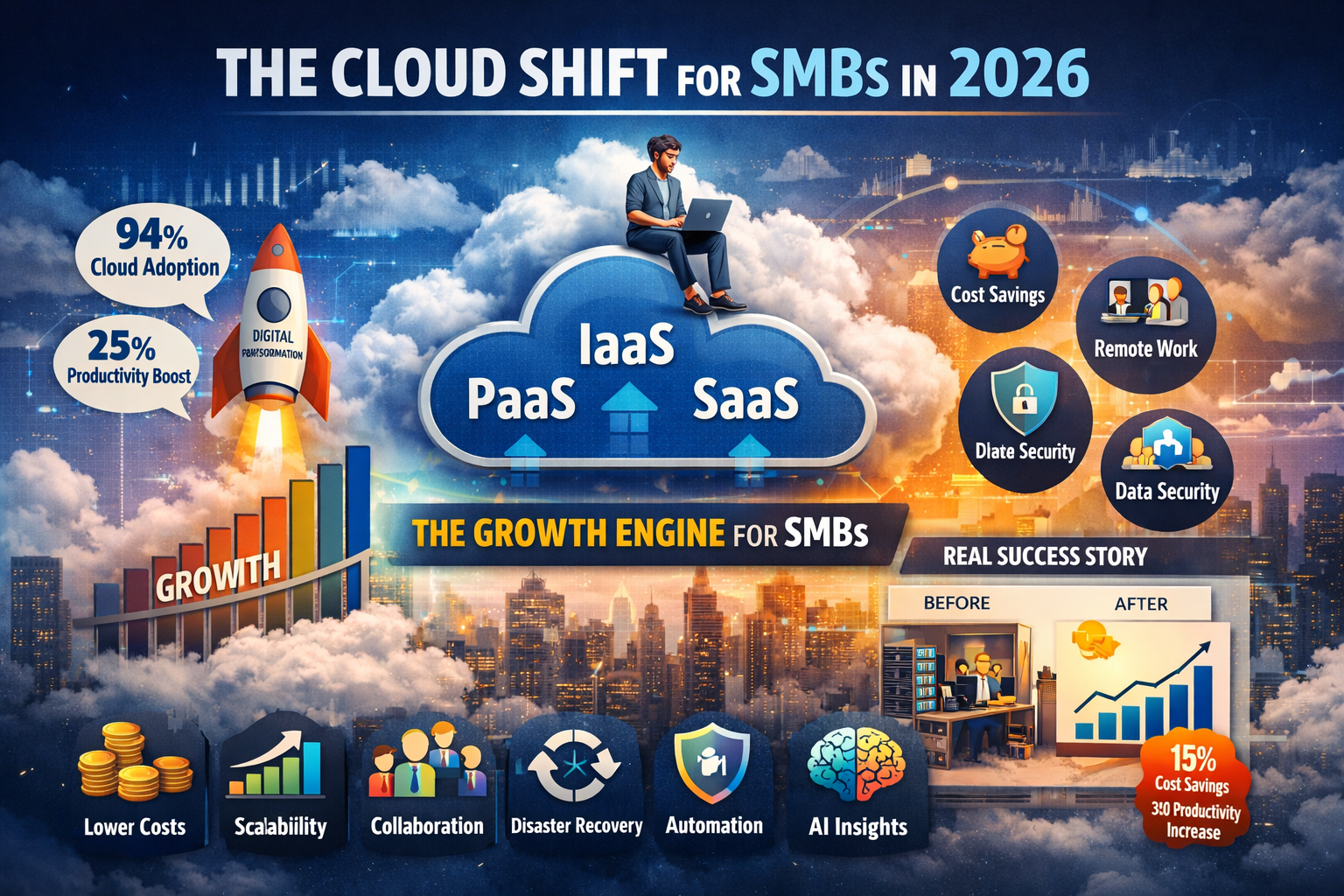
Recent market data shows how
massive the cloud shift has become. By 2026, more than 94–96% of companies
globally are using cloud services, and roughly 63% of SMB workloads and
data are already cloud-hosted.
In India specifically, around 60% of SMBs are already using cloud technology,
with adopters reporting productivity improvement of 25–30% and
operational cost reduction of 15–20%.
What Are Cloud Solutions? (Quick Refresher for SMB
Owners)
Cloud computing means
storing data, running software, and managing IT infrastructure over the
internet instead of local servers or personal computers. Instead of buying
expensive hardware, businesses rent computing resources from cloud providers.
Types of Cloud Services
1.IaaS
(Infrastructure as a Service)
Provides virtual servers, storage, and networking. Example: AWS EC2.
2.PaaS
(Platform as a Service)
Provides development platforms for building apps. Example: Google App Engine.
3.SaaS
(Software as a Service)
Ready-to-use software delivered via browser.
Example: Google Workspace, Zoho,
Microsoft 365.
Cloud Deployment Models
*Public
Cloud: Shared infrastructure
(cost-effective)
*Private
Cloud: Dedicated infrastructure
(high security)
*Hybrid
Cloud: Mix of both (flexibility +
control)
Why SMBs Are Rapidly Moving to Cloud in 2026
Several forces are pushing
SMBs toward cloud adoption:
1.Inflation and cost
pressure
2.Remote and hybrid
workforce demand
3.Increasing cyber threats
4.Need for fast scalability
5.Faster innovation cycles
In fact, SMBs are now
allocating over 50% of their technology budgets to cloud services,
showing how central cloud has become to business strategy.
7 Ways Cloud Solutions Transform SMBs
1. Massive Cost Reduction
*No hardware investment
*Pay-as-you-go pricing
*Lower maintenance costs
2. Scalability Without Stress
*Scale resources instantly
*No infrastructure upgrades
*Perfect for growing
startups
3. Remote Work & Collaboration
*Access from anywhere
*Real-time document sharing
*Cloud project management
tools
Cloud collaboration tools
are now used by over 90% of companies, showing how normal remote cloud
workflows have become.
4. Improved Data Security
*Enterprise-grade encryption
*Continuous updates
*Secure backup systems
5. Business Continuity & Disaster Recovery
*Automatic backups
*Faster recovery after
failures
*Minimal downtime
6. Automation & Operational Efficiency
*Automated workflows
*Cloud CRM & ERP
integration
*Reduced manual errors
7. Data-Driven Decision Making
*Real-time dashboards
*Cloud analytics tools
*AI-powered insights
Real-Life Example: SMB Growth Using Cloud
Before
Cloud:
*Manual accounting
*Local servers
*Limited remote access
After
Cloud:
*Cloud ERP + CRM
*Remote team productivity
*Automated reporting
Results
(Typical Industry Pattern):
*15–20% cost reduction
*25–30% productivity
improvement
Cloud Challenges SMBs Should Be Aware Of
1.Data migration complexity
2.Vendor lock-in risk
3.Internet dependency
4.Employee skill gaps
How to Overcome Them
*Choose multi-cloud or
hybrid strategies
*Train employees early
*Work with cloud consultants
*Start with non-critical
workloads
How to Successfully Implement Cloud Solutions
1.Assess business needs
2.Select the right cloud provider
3.Start small and scale gradually
4.Train employees
5.Monitor performance and costs
The Future of Cloud for SMBs Beyond 2026
The next phase of cloud
evolution will include:
1.AI + Cloud integration
2.Edge computing growth
3.Industry-specific cloud
platforms
4.Hyper-automation
Cloud is becoming the
foundation of modern digital business ecosystems, not just an IT tool.
Conclusion:
Cloud Is the Growth Engine for SMBs
Cloud computing is
transforming how SMBs operate, compete, and grow. From cost savings and
security to remote work enablement and data-driven decisions, cloud is
redefining business efficiency.
The message for SMB owners
is clear:
1.Consult IT experts
2.Upgrade legacy systems
3.Start your digital
transformation now
In 2026 and beyond,
businesses that adopt cloud early will scale faster, innovate quicker, and
compete globally — while those relying on traditional IT risk falling behind.